The Science of Creatine

The biochemical foundation of modern performance, recovery, and cellular energy science.

Cellular Energy & ATP Regeneration

Creatine plays a fundamental role in cellular bioenergetics by supporting rapid regeneration of adenosine triphosphate (ATP), the body’s primary energy molecule. Approximately 95% of total creatine stores are located in skeletal muscle, where phosphocreatine acts as a rapid phosphate donor during high-intensity effort. This mechanism enables sustained power output, improved work capacity, and delayed fatigue during repeated bouts of exertion.

Approximately 1–2% of total body creatine is naturally converted to creatinine and excreted each day, requiring continuous replenishment through endogenous synthesis and dietary intake.

Muscle, Brain & Whole-Body Physiology

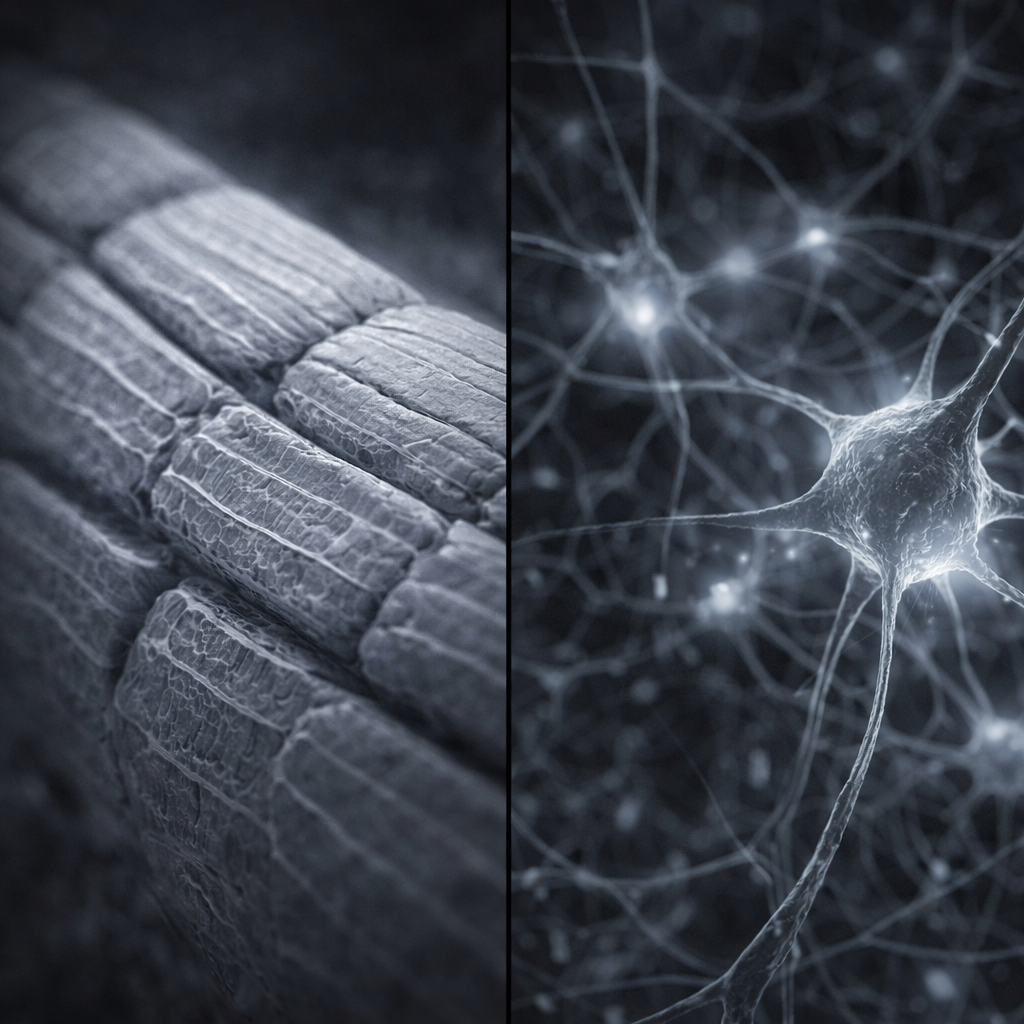
Although traditionally associated with strength performance, creatine’s biological role extends to multiple organ systems. High-energy tissues such as muscle and brain rely on rapid ATP turnover, making creatine relevant for neuromuscular function, cellular resilience, and metabolic regulation.

Emerging evidence shows that creatine may support cognitive processing, memory, and attention, particularly under demanding conditions or in aging populations.
LEARN MORE

Supplementation & Recognized Intake

Daily supplementation of 3–5 grams of creatine monohydrate has been shown to increase intramuscular phosphocreatine stores over time. The European Food Safety Authority (EFSA) recognizes that a daily intake of 3 grams increases physical performance in successive bursts of short-term, high-intensity exercise.

Higher daily intakes (e.g., 10–20 grams) have been investigated in specific clinical and aging-related research contexts, including studies examining neuromuscular and cognitive outcomes. While some preliminary findings suggest potential additional effects in certain populations, further research is required before such intakes can be considered standard practice.
Evidence-Supported Functional Benefits

Strength, Power & Lean Mass

Controlled trials consistently demonstrate increases in lean body mass, muscular strength, and training adaptations with supplementation, both with and without resistance training.

Recovery & Fatigue Reduction

Randomized studies report improvements in recovery from muscle damage, reduced fatigue, and faster restoration of force output following strenuous exercise.

Cognitive & Neuromotor Performance

Research indicates benefits in tasks requiring simultaneous mental and physical processing, including improvements in reaction time, technical execution, and perceived exertion.

Metabolic & Glucose Regulation

Supplementation combined with exercise has been associated with improved insulin sensitivity and enhanced glucose transport via GLUT-4 activity in skeletal muscle.

Healthy Aging & Functional Longevity

Evidence suggests creatine may support muscle, bone, and cognitive health in older adults, particularly when combined with structured training programs.

Safety & Clinical Validation

Creatine monohydrate remains the most clinically validated and regulatorily recognized performance ingredient in nutritional science. Regulatory safety evaluations and long-term human trials consistently demonstrate a strong safety profile when consumed at recommended intake levels and manufactured according to established purity specifications.

REQUEST SPECS
Relevance for Modern Formulation Science

Because of its well-defined mechanisms, reproducible physiological outcomes, and compatibility with diverse delivery systems, creatine remains a highly versatile ingredient for product development. Its scientific credibility, stability, and broad evidence base support its application in formulations targeting performance, recovery, cognitive support, metabolic health, and healthy aging populations.

In practical formulation environments, parameters such as solubility and dispersion characteristics contribute to consistent dosing and product performance across different delivery systems.

References

  1. Aguilar, Fernando & Autrup, Herman & Barlow, Susan & Castle, Laurence & Crebelli, Riccardo & Dekant, Wolfgang & Engel, Karl-Heinz & Gontard, Nathalie & Gott, David & Grilli, Sandro & Gürtler, Rainer & Larsen, John-Christian. (2004). Opinion of the Scientific Panel on Food Additives, Flavourings, Processing Aids and Materials in contact with Food (AFC) on a request from the Commission. EFSA J. 104.
  2. Ben Maaoui, K., Delleli, S., Mahdi, N., Jebabli, A., Del Coso, J., Chtourou, H., ... & Ouergui, I. (2025). Effects of Creatine Monohydrate Loading on Sleep Metrics, Physical Performance, Cognitive Function, and Recovery in Physically Active Men: A Randomized, Double-Blind, Placebo-Controlled, Crossover Trial. Nutrients, 17(24), 3831.
  3. Bonne, T. C., Arthemalle, V., Doherty, C. S., Andersen, A. B., Bejder, J., Ehlers, T., ... & Nordsborg, N. B. (2025). Muscle creatine levels and sprint performance in young adult vegans and vegetarians after 7 days of creatine monohydrate supplementation. Physiological Reports, 13(17), e70539.
  4. Candow, D. G., & Moriarty, T. (2025). Effects of creatine monohydrate supplementation on muscle, bone and brain-hope or hype for older adults?. Current Osteoporosis Reports, 23(1), 1.
  5. Candow, D. G., Kirk, B., Chilibeck, P. D., & Duque, G. (2025). The potential of creatine monohydrate supplementation in the management of osteosarcopenia. Current Opinion in Clinical Nutrition & Metabolic Care, 28(3), 235-239.
  6. Desai, I., Pandit, A., Smith-Ryan, A. E., Simar, D., Candow, D. G., Kaakoush, N. O., & Hagstrom, A. D. (2025). The effect of creatine supplementation on lean body mass with and without resistance training. Nutrients, 17(6), 1081.
  7. Gutiérrez-Hellín, J., Del Coso, J., Franco-Andrés, A., Gamonales, J. M., Espada, M. C., González-García, J., ... & Varillas-Delgado, D. (2025). Creatine Supplementation Beyond Athletics: Benefits of Different Types of Creatine for Women, Vegans, and Clinical Populations—A Narrative Review. Nutrients, 17(1), 95.
  8. Mănescu, A. M., Hangu, S. Ș., & Mănescu, D. C. (2025). Nutritional Supplements for Muscle Hypertrophy: Mechanisms and Morphology—Focused Evidence. Nutrients, 17(22), 360
  9. Marshall, S., Kitzan, A., Wright, J., Bocicariu, L., & Nagamatsu, L. S. (2026). Creatine and cognition in aging: a systematic review of evidence in older adults. Nutrition reviews, 84(2), 333-344.
  10. Młynarska, E., Leszto, K., Katańska, K., Prusak, A., Wieczorek, A., Jakubowska, P., ... & Franczyk, B. (2025). Creatine supplementation combined with exercise in the prevention of type 2 diabetes: effects on insulin resistance and sarcopenia. Nutrients, 17(17), 2860.
  11. Salem, A., Ammar, A., Kerkeni, M., Boujelbane, M. A., Merve Uyar, A., Moritz Köbel, L., ... & Chtourou, H. (2025). Short-term creatine supplementation enhances strength, reduces fatigue, and accelerates recovery in resistance-trained athletes: a double-blind, randomized, crossover trial. Journal of the International Society of Sports Nutrition, 22(sup1), 2617283.
  12. Smith-Ryan, A. E., DelBiondo, G. M., Brown, A. F., Kleiner, S. M., Tran, N. T., & Ellery, S. J. (2025). Creatine in women’s health: bridging the gap from menstruation through pregnancy to menopause. Journal of the International Society of Sports Nutrition, 22(1), 2502094.
  13. Smith, A. N., Sullivan, D. K., Morris, J. K., Carbuhn, A. F., Herda, T. J., & Taylor, M. K. (2025). Eight weeks of creatine monohydrate supplementation is associated with increased muscle strength and size in Alzheimer’s disease: data from a single-arm pilot study. Frontiers in Nutrition, 12, 1670641.
  14. Wu, J., Qiu, P., & Li, Y. (2025). Acute creatine supplementation enhances technical performance in adolescent basketball players under cognitive-motor dual-task condition. Journal of the International Society of Sports Nutrition, 22(sup1), 2542369.
  15. Yamaguchi, S., Inami, T., Nishioka, T., Morito, A., Ishiyama, K., & Murayama, M. (2025). The Effects of Creatine Monohydrate Supplementation on Recovery from Eccentric Exercise-Induced Muscle Damage: A Double-Blind, Randomized, Placebo-Controlled Trial Considering Sex and Age Differences. Nutrients, 17(11), 1772.